Sunday, March 10, 2013

Scout Hike

We wrote an earlier post on the Scout Camp we attended on February 6-7, 2013.  The 6th graders (Prathom 6) and 9th graders (Mattayom 3) from the Baan Nong Phue School attended the camp, out in the country about 40 minutes from the school, with students from other schools in the region.  We learned a lot about Thai scouting on that trip and had fun with a lot of great people.

Recently we learned that there is additional scouting activity at this time of year - focused on the rest of the students who didn't get to attend the Scout Camp this year: on Friday, March 1st, the 5th graders and the 7th and 8th graders went on a long hike in the countryside near the school.  The temperature reached 101 degrees F. that day, so Mary passed (and stayed at school to teach some classes), but George went.  Since this story is narrated only by George, he'll switch to the first person to make it simpler. 

I was asked whether I wanted to walk with the students or go with the teachers.  Not knowing what was in store, I said, go with the students, but was quickly advised by a teacher to go with them.  So I did.  It turned out that it was a pretty long hike and the students walked while the teachers rode in air conditioned cars to their stations, where they waited in the shade for the students to come by, made sure they were all OK, and gave them water.  I was glad about the decision to go with the teachers!

When teacher and friend Thanorm and I got to Thanorm's station, it was early - well before the students would arrive, so I went for a walk.  I walked through a grove of Hevea trees - a natural source of rubber - and past what I assume is a shelter for the farmers during the season for tapping the trees.


The trees aren't tapped until they reach maturity (about 7 years).  Tapping them involves cutting the bark, severing latex vessels.  Each time the tree is tapped, a channel is prepared along which the latex flows.  This method avoids wounding the trees.


We're in the "dry season" and it really is that - we've seen hardly any rain since we arrived in Khemmarat in early November last year.  The only significant rain we remember was a heavy shower during the Loi Krathong Festival on November 28th last year and that only lasted an hour or so.  The rainy season is supposed to start in late April to early May.  The land is very dry now and the trees look stressed, but, to our amazement, plants spring new buds and flowers every week.  We assume it will be very green here by August.  These pictures should give an idea of what it's like now.


Even the Hevea trees are blooming despite the drought:


I found this and was told it's not edible

 
and saw a beautiful butterfly:


Thanorm showed me a stack of cut cassava and explained about the shrub, which is widely cultivated in Thailand and other tropical countries for both human and animal consumption.  The plant's starchy, tuberous root is edible and a major source of carbohydrates, but poor in protein.  According to Wikipedia, it is drought-tolerant and capable of growing in marginal soils.  Cassava naturally produces cyanide, so proper preparation (leaching and drying) is very important to avoid cyanide intoxication and potentially death.  Cassava starch is also the source of tapioca.

Cassava is harvested by pulling the roots out of the ground and removing them from the base of the plant.  The plant is propagated by cutting the stem into short sections; these are planted prior to the rainy season.


There are many large cisterns around rural Thailand like the one pictured below.  They are used to catch and store rainwater.  Thanorm told me that, in one of many of a variety of different jobs in his younger years, he sold these -- it took three men to carry one.


Thanorm suggested that I ride with Scout chief Parinwat and visit the other stations.  The first station (A3, marked on the tree) was manned by Chandwit and Toon (center and right); that's Parinwat on the left.


As Parinwat drove the route the students were hiking, we would run into groups of them and Parinwat would give them water.


The second station (a food shop on the highway) was manned by Giap (computer teacher, left) and his friend Tanagon, a music teacher from another school.


The last station I saw was manned by Baan Nong Phue music teacher and band director Watit.  Note the stacks of cassava behind him.


The Scouts got water and then lined up to get their faces smeared with ashes.


Then they were off as a new group arrived.


Thanks to Parinwat, Thanorm, Watit, and the rest of the Scout leaders for a comfortable, interesting, and fun "hike."


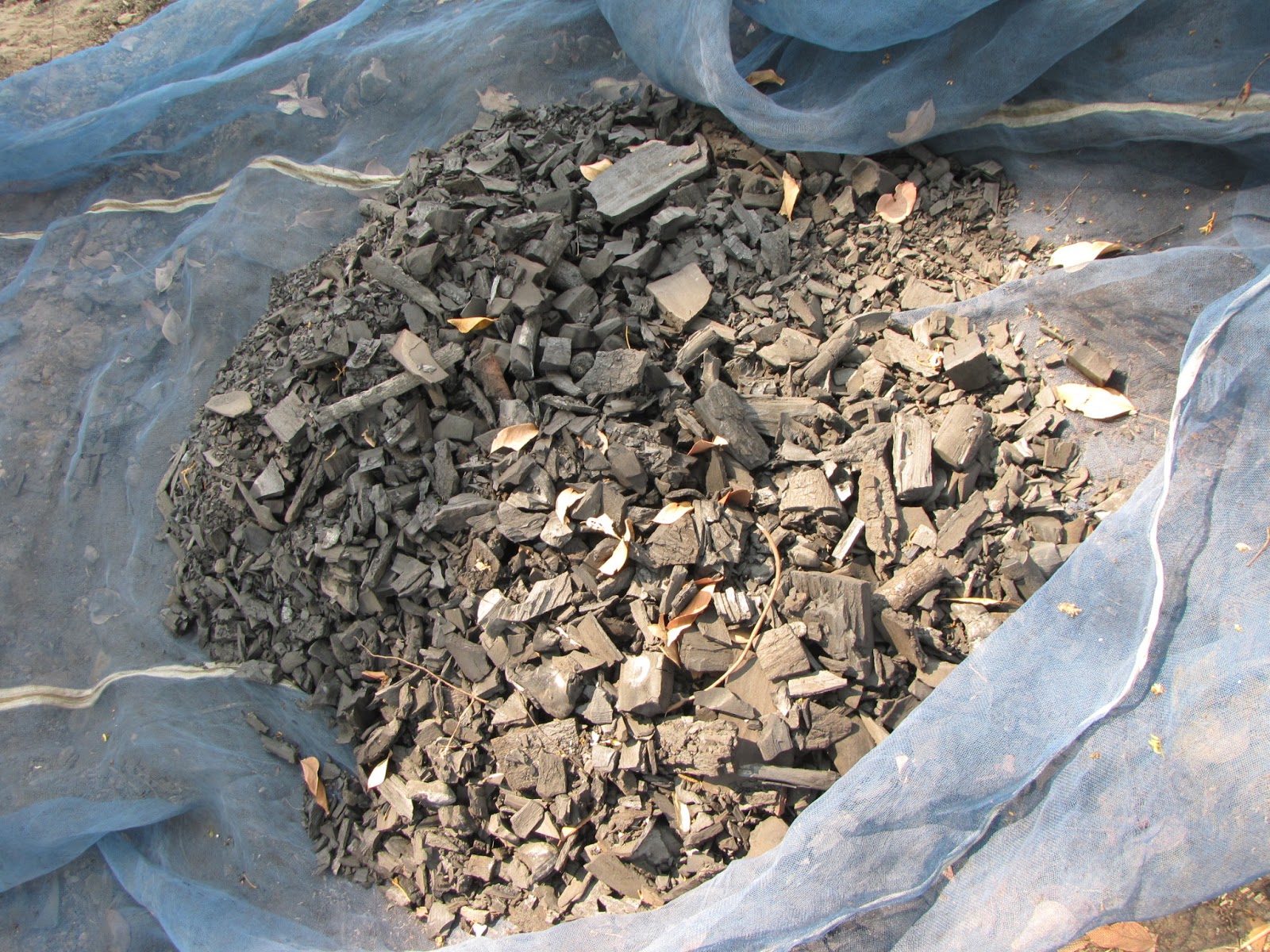
Mary and I have seen a number of large, mud-colored mounds with openings in them, around Khemmarat and Baan Nong Phue and wondered what they were.  By Watit's station, I saw one up close and learned that they are "ovens" to make charcoal.


If you want to learn more about charcoal making in Thailand (as Mary and I did), here's a link to an informative YouTube video:  http://www.youtube.com/watch?v=N6qTf1IdMvY

Next Thanorm and Chandwit took me to Wat Tam Pha Phuang (cave temple).  


Unlike the other figures on the temple grounds, the figure below was small -- about a foot tall.


Then Thanorm drove us to his house.


That's teak wood on the right side of the photo, which Thanorm uses for building.

Thanorm's beautiful, young daughter Piyapat was sitting on her aunt's lap on a platform in front of the house with friends.


Before we headed back to school for lunch, we joined up with many of the teachers who had been at various stations on the hike route and I got a chance to talk with them more than I usually do at school.


The teachers had a nice lunch back at school.


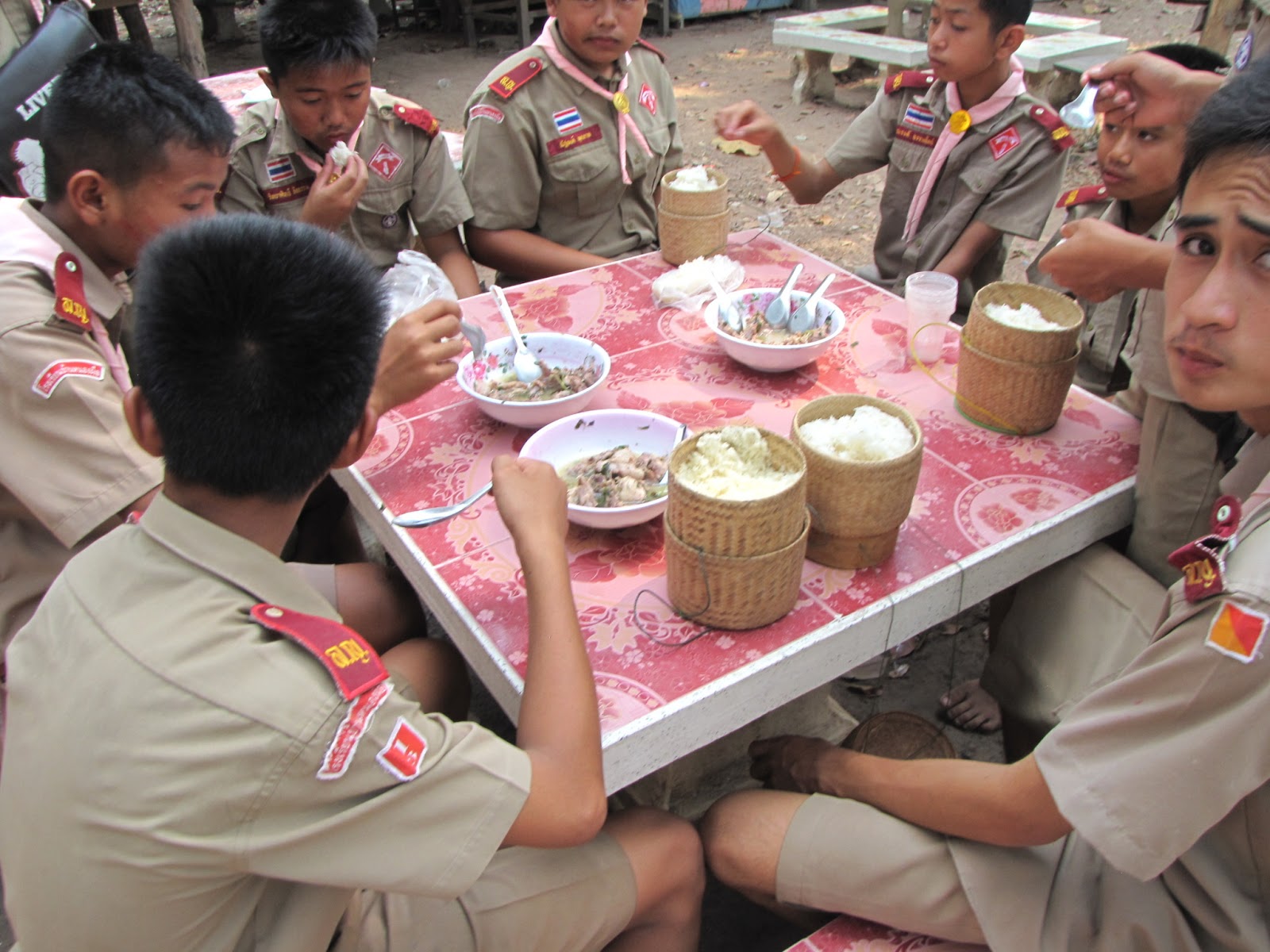
And I was able to see the Scouts doing some very fancy food preparation.


Before I left school that day, I noticed that pictures of Mary and me had been added to the board outside the Director's office with photos of all the teachers and staff of the school.  That's us near the bottom: Mary's holding flowers and we both have Valentine's Day stickers on our shirts -- part of the Baan Nong Phue family!


Thursday, March 07, 2013

Theo Update - March 7, 2013

We posted a Theo Update on November 14th of last year, and then there were lots of pictures of, and stories about, Theo in the January 2013 posts of our adventures in Taipei in December.  But it's been awhile and Theo's had a birthday so we decided it's time for a new update.

On February 11th, Theo reached his 1st birthday.


Riley and Joel decorated with pictures of Theo from throughout his first year.


There was a big party with an enthusiastic rendition of "Happy Birthday to You" - a little too enthusiastic for Theo's taste.


But Riley had made a healthy birthday cake,


and a slice of that cheered him right up.


Theo enjoyed his presents and his guests.


He also tried on an outfit from the Night Market in Chiang Mai, Thailand.


Congratulations, Theo!


On February 21, Theo had a playdate with his friend Max.  Many thanks to Max's mom Laura for sharing these photos.


Sunday, March 03, 2013

A Lovely Afternoon in Amnat Charoen

George got a message Saturday evening from our friend Tong Jeaboon offering to drive from Ubon (about an hour and a half away) to pick us up on Sunday morning and take us to Amnat Charoen (about 42 miles from Khemmarat) for lunch with our new friend Oy Crowdy.  We accepted, although with some misgivings about all the driving that would mean for Tong, her husband Sombat, and son Kong.  (Regular blog readers may remember Sombat, Tong, and their children Boogie and Kong, from our January 27 post, "English Camp at Baan Bohin.")  Tong, Sombat, and I had just met Oy at a teacher training workshop in Baan Laithung (where Sombat is School Director) on Wednesday, February 27. (Watch for an upcoming blog post on the training workshop.)  Oy is a Thai woman who married an Englishman and has lived in London for 20 years, traveling to Thailand about twice a year.  Oy and George served as trainers at the workshop.

After a few very hot days (temps around 100 degrees F), Sunday was a beautiful, mild day.  Once we arrived in Amnat, we stopped in the center of the city and waited for Oy to drive in and lead us back to her home in the country.  While we waited, we toured the public library.


There was a children's room with many books, including some in English.


One young boy was brave enough to sit with a couple farang.


A library attendant gave Sombat and the rest of us a tour of the displays upstairs.


We understand that the figures below are involved in sports.  We recognize the guy in back as being on stilts; the guy in front of him is doing something with coconut shells; we're not sure about the two guys in front -- looks more like some farming activity to us.


George (after14 years of work with E-rate, a US program to support information technology in schools and libraries) was struck by the computers available to the public in the front of the library.


On entering the library, one sees a display about the Association of Southeast Asian Nations (ASEAN), which includes Brunei, Cambodia, Indonesia, Laos, Malaysia, Myanmar, Philippines, Singapore, Thailand, and Vietnam.  The ASEAN "Blueprint" establishes a Human Development goal to  enhance the well-being and livelihood of the people of ASEAN by providing them with equitable access to ... education and life-long learning,  ... promote the use of English language [and] Information Communication and Technology ....

It is that ASEAN goal that is behind the national movement in Thailand to promote English proficiency among students in Thai schools.


Under the shield above the display, there is small book with the picture of Thai Princess Sirindon (we were told the shield features her name).  She is the third child of King Bhumidol and Queen Sirikit and in line to the throne.  It is said she is often referred to as the "Princess of Information Technology," due to her interest and expertise in applying science for the country's development.  She holds a doctorate in Education Development and is said to be a particular patron of the Nation's libraries.  Her picture was displayed widely throughout the library.  The book shows pictures of her cooking, said to be another of her loves.


It was a very interesting visit to a beautiful public building.  Then we made our way into the country.  Though it is in the country, this is the front of Oy's house:


She gave us a quick tour. This is the view from inside the front door.


Then attention turned to dinner.  Oy had told us she loved cooking and was a good cook.  By the middle of dinner, we heartily agreed!


Dessert, as is traditional in Thailand, was fruit: longgans, guavas, and dragon fruit.  We had posted a picture of a purple dragon fruit once before, but we post it again for comparison now with its white and black interior.


Oy gave us a tour of her backyard garden.  She grows lemon grass and had dried some to take back to England with her.


Her garden has many lovely plants; here are a few.


We were offered some ant eggs; we declined since we were so full ("im laew") ; )


Here we are saying goodbye to Oy and her relatives who helped with dinner. 


Thank you so much, Oy, Tong, Sombat, and Kong, for a very lovely afternoon.

Mary and George